"Light precedes every transition. Whether at the end of a tunnel, through a crack in the door or the flash of an idea, it is always there, heralding a new beginning."
—Teresa Tsalaky
With the final days of Google+ being imminent, the people of the storied "ghost town" are becoming a small-d diaspora, scattering to various other social spaces.
Some of us are already out there, on Twitter, Facebook, Instagram... Let us hope we bring the best aspects of our personae with us to inform these prior "selves," the ones that you may already believe you know. Each space has its own affordances, interfaces, and circles of contacts, influencing our interactions for better or worse.
Other former Plussers are branching out into less well-known spaces, seeking out old friends in new guises, or deliberately seeking a different experience. And still others are carving out a secure corner in their own thriving domains/spaces to accommodate the spirit that was G+. I'll mention and link to many of them as we get re-established.
For now, though, I have finally followed role models and friends such as Laura Gibbs, Terence Towles Canote, Keith Wilson, Clay Forsberg, and Bryan Alexander back into the blogosphere. You can see I've chosen the safe route of just cleaning up an old space from the early 2010s, and deleting the posts and widgets that don't hold up. Pardon the dust!
To be honest, though, I have plenty of online activity as it is on Twitter and Facebook. One major "why bother," impetus for my return to The Rift, is really that PLN friends/colleagues Kate Bowles and Benjamin Doxdator set off a spark a few days ago that deserves a response. I needed room to flex a bit. I'll get to it soon.
Meanwhile, look for me on Twitter as harmonygritz. Please don't take it (too) personally if I don't friend everyone I encounter on Facebook.
Sunday, March 31, 2019

Saturday, September 7, 2013
Power over Technology Concedes Nothing without a Demand
"Technology empowers the user and takes power from those who want to be in charge." —Lisa Nielsen of The Innovative Educator (blog and Facebook Group).
The above quote is from a Facebook conversation earlier today about BYOD (Bring Your Own Device) a.k.a. BYOT (...Technology) in the conventional classroom. We also had a couple of nice tangents about how the concept may apply to educators in different settings.
Overall, Lisa's quote makes a point I want to help my students understand—that it doesn't have to be the session leader's way or the highway, with technology just reinforcing existing hierarchies. I think a look at how "adults" act in BYOD situations may help inform our decisions about how to work with students. In other words, it may not be that hard to figure out.
In faculty meetings, it's important for the "people in charge" not to waste meeting time doing stuff that makes attendees want to go to their computers or mobile devices. Then a supervisor or chair doesn't have to "play teacher," looking askance at faculty who are indeed checking mail, chatting, texting, or doing class prep instead of hanging on every word of an esteemed presenter. Even with a worthwhile agenda, poor use of technology in a roomful of people talking about innovation seems to put everyone at cross purposes.
One reason that "conventional educators" are connecting with PLNs (Personal Learning Networks) on Google+, Facebook, and Twitter is because we can't seem to sustain the same quality of conversations locally—except with a few colleagues in informal settings. In larger gatherings such as department or college meetings, it only takes a couple of naysayers to shut you down when you suggest that better use of technology or a bit of common sense might improve meeting procedures. They pick up the scent of a challenge to Parkinson's Law of Triviality and will generally not put up with it for long.
Something related applies to learners in the classroom, of course, and that is where today's BYOD conversation began. Some of us are finally catching on: Don't waste time doing stuff (or putting out info, or testing on discrete factoids) that the students can Google for themselves. One DOES have to spend time on context, and the importance of knowing what to Google, and why it matters to know this. That's a harder conversation to have, and you (okay, I) may lose some very traditional students who want to be spoon-fed and then to regurgitate at mid-term or final in the time-honored fashion. (Rather than just settle for some attrition, I know I must come back to this elsewhere. Suggestions welcome!)
I am not yet sure how to address another aspect of the larger #edtech question: How not to go all colonialist or missionary on your learners, and "help" people in ways that are "for their own good" without respecting their input. Here you go, have some appropriate technology! Except that we can be mindful and listen carefully for what help learners may actually want/need. I am going down this road with my classes now, albeit slowly. I'm not sure what I'd do in a more locked-down K12 district telling me through official policy what tech to use or not use in my classroom.
The above quote is from a Facebook conversation earlier today about BYOD (Bring Your Own Device) a.k.a. BYOT (...Technology) in the conventional classroom. We also had a couple of nice tangents about how the concept may apply to educators in different settings.
Overall, Lisa's quote makes a point I want to help my students understand—that it doesn't have to be the session leader's way or the highway, with technology just reinforcing existing hierarchies. I think a look at how "adults" act in BYOD situations may help inform our decisions about how to work with students. In other words, it may not be that hard to figure out.
In faculty meetings, it's important for the "people in charge" not to waste meeting time doing stuff that makes attendees want to go to their computers or mobile devices. Then a supervisor or chair doesn't have to "play teacher," looking askance at faculty who are indeed checking mail, chatting, texting, or doing class prep instead of hanging on every word of an esteemed presenter. Even with a worthwhile agenda, poor use of technology in a roomful of people talking about innovation seems to put everyone at cross purposes.
 |
| My bestest PLN-space so far |
Something related applies to learners in the classroom, of course, and that is where today's BYOD conversation began. Some of us are finally catching on: Don't waste time doing stuff (or putting out info, or testing on discrete factoids) that the students can Google for themselves. One DOES have to spend time on context, and the importance of knowing what to Google, and why it matters to know this. That's a harder conversation to have, and you (okay, I) may lose some very traditional students who want to be spoon-fed and then to regurgitate at mid-term or final in the time-honored fashion. (Rather than just settle for some attrition, I know I must come back to this elsewhere. Suggestions welcome!)
I am not yet sure how to address another aspect of the larger #edtech question: How not to go all colonialist or missionary on your learners, and "help" people in ways that are "for their own good" without respecting their input. Here you go, have some appropriate technology! Except that we can be mindful and listen carefully for what help learners may actually want/need. I am going down this road with my classes now, albeit slowly. I'm not sure what I'd do in a more locked-down K12 district telling me through official policy what tech to use or not use in my classroom.
Friday, June 17, 2011
Happy 2nd Anniversary, CSUMB and Google Apps!
It's been two years since CSU Monterey Bay took Google Apps to be its lawfully wedded cyber-spouse. (Aren't June weddings wonderful?)
 CSUMB kept one relative in the attic for about a year: FirstClass was our departing e-mail client/server system and we kept it in the background to be able to access our old messages. (MeetingMaker, the campus's official scheduling software, simply disappeared like an angry ex not invited to the nuptials.) Meanwhile, Google brought a passel of its own kids into the relationship. But only three were invited right into the house and given their own bedrooms: Gmail, Google Calendar, and Google Docs.
Other Apps such as Sites were left to fend for themselves at first. Instead of prominent CSUMB dashboard links, for example, there would be smaller links on our Gmail page, that sort of thing. Over these two years, most of my students had never even clicked on the Sites link until required to do so for my class. (That's not a complaint, just an observation that you get the behavior you design for.)
Google Docs may finally be in early majority stage, beyond the early adopters. After a year or so of "But we need Microsoft for everything" and about 50 other excuses, I'm seeing it used more for collaboration by known non-techie faculty members.
Here's an interesting commentary on how the first two years went (but nothing about a 2nd Anniversary Celebraganza??) by Greg Pool, who is CSUMB's Lead Web Publishing Coordinator. Greg has some intriguing comments about Google Moderator. I thought I would be one of the first to use it on campus next fall, but apparently somebody snuck by me!
http://googleenterprise.blogspot.com/2011/06/csu-monterey-bay-offers-dozens-of-new.html
____________
(Google Logo Generator is at: http://neswork.com/logo-generator/google-font)
 CSUMB kept one relative in the attic for about a year: FirstClass was our departing e-mail client/server system and we kept it in the background to be able to access our old messages. (MeetingMaker, the campus's official scheduling software, simply disappeared like an angry ex not invited to the nuptials.) Meanwhile, Google brought a passel of its own kids into the relationship. But only three were invited right into the house and given their own bedrooms: Gmail, Google Calendar, and Google Docs.
Other Apps such as Sites were left to fend for themselves at first. Instead of prominent CSUMB dashboard links, for example, there would be smaller links on our Gmail page, that sort of thing. Over these two years, most of my students had never even clicked on the Sites link until required to do so for my class. (That's not a complaint, just an observation that you get the behavior you design for.)
Google Docs may finally be in early majority stage, beyond the early adopters. After a year or so of "But we need Microsoft for everything" and about 50 other excuses, I'm seeing it used more for collaboration by known non-techie faculty members.
Here's an interesting commentary on how the first two years went (but nothing about a 2nd Anniversary Celebraganza??) by Greg Pool, who is CSUMB's Lead Web Publishing Coordinator. Greg has some intriguing comments about Google Moderator. I thought I would be one of the first to use it on campus next fall, but apparently somebody snuck by me!
http://googleenterprise.blogspot.com/2011/06/csu-monterey-bay-offers-dozens-of-new.html
____________
(Google Logo Generator is at: http://neswork.com/logo-generator/google-font)
Sunday, June 5, 2011
National Academies Press: All PDF books free all the time
Sunday, May 29, 2011
What educators spend their spare time thinking about
Even on this fine Memorial Day weekend, a couple of interesting online conversations are in progress, led by people I have deemed to be in my personal learning network (PLN) whether they know it or not. Rather than try to reproduce them here, I've given a brief lead-in and link to each.
Conversation #1 is at Ferdinand von Prondzynski's "A University Blog" and starts with what looks like a publicity stunt by Peter Thiel, Paypal's co-founder. As usual, though it's really about the very nature of higher education itself, and whether $100,000 is a fair trade to abandon (or delay) a liberal education.
Conversation #2 is at CSU Dominguez Hills colleague Larry Press's blog for his CIS 471 (Network-Based Applications) class. It starts innocently enough with a short review of the text Multimedia Learning (Mayer, 2009). But it's really about the clandestine PowerPoint wars that have been going on ever since Microsoft's business software invaded the world of teaching and learning. If you love or hate either Edward Tufte or Sherry Turkle you should drop by Larry's blog and check it out.
Conversation #1 is at Ferdinand von Prondzynski's "A University Blog" and starts with what looks like a publicity stunt by Peter Thiel, Paypal's co-founder. As usual, though it's really about the very nature of higher education itself, and whether $100,000 is a fair trade to abandon (or delay) a liberal education.
Conversation #2 is at CSU Dominguez Hills colleague Larry Press's blog for his CIS 471 (Network-Based Applications) class. It starts innocently enough with a short review of the text Multimedia Learning (Mayer, 2009). But it's really about the clandestine PowerPoint wars that have been going on ever since Microsoft's business software invaded the world of teaching and learning. If you love or hate either Edward Tufte or Sherry Turkle you should drop by Larry's blog and check it out.
Thursday, May 26, 2011
One good thing comes out of every meeting
With your consent, gentle reader, I'll condense and "chunk" my impressions from a week chock-full of faculty meetings, instead of doing one long post. There's still a follow-up with just me and CSUMB's School of ITCD chair on Friday afternoon and I'm running out of steam.
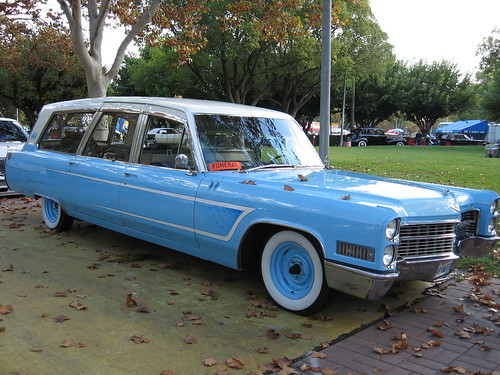 Yesterday in our full session I suggested holding a funeral/wake for our old, maligned, rather hoary one-size-fits-all technology curriculum, CST101 (Technology Tools). It has about a year left in its current incarnation, because our campus is unveiling a new academic model in Fall 2012. The concept of the funeral/wake was only mildly amusing to the room-- as there are (to put it mildly) mixed feelings among the long-term lecturers, a reluctance to put our formerly robust horse-- er, course-- out to pasture. But I'll bring it up again in the fall. A ceremony w/ blue hearse and church ladies serving congealed salad seems a great idea. And I'm the course coordinator, so there.
Meanwhile, there came another idea from a computer science colleague. She wanted the 101 lecturers to acknowledge that the course's reputation on campus would not be getting any better, nor would our department's reputation by continued association with it. Indeed, our clinging to it was akin to rural Pennsylvanians clinging to guns or religion or antipathy to people who aren't like them. (I think that's what a couple of people in the room heard, anyway.)
So I thought, why not go all the way? Why not declare a full moratorium on use of the term "Tech Tools"? This, unlike the wake idea, got a little play in the room. Even our esteemed Dean seemed to go along. I have therefore established "the kitty," which is for the moment a paper cup. Twenty-five cents goes in with each mention of [the course that shall not be named]. We have already heard it called [the Voldemort course] so we may be on a roll.
ETA: Hm, this recent Tom Schimmer post called "Envision the 'Best-Case' Scenario" seems to be pertinent. Canadians. Hm.
___________
*Blue hearse courtesy of braintoad's Flickr photostream
Meanwhile, there came another idea from a computer science colleague. She wanted the 101 lecturers to acknowledge that the course's reputation on campus would not be getting any better, nor would our department's reputation by continued association with it. Indeed, our clinging to it was akin to rural Pennsylvanians clinging to guns or religion or antipathy to people who aren't like them. (I think that's what a couple of people in the room heard, anyway.)
So I thought, why not go all the way? Why not declare a full moratorium on use of the term "Tech Tools"? This, unlike the wake idea, got a little play in the room. Even our esteemed Dean seemed to go along. I have therefore established "the kitty," which is for the moment a paper cup. Twenty-five cents goes in with each mention of [the course that shall not be named]. We have already heard it called [the Voldemort course] so we may be on a roll.
ETA: Hm, this recent Tom Schimmer post called "Envision the 'Best-Case' Scenario" seems to be pertinent. Canadians. Hm.
___________
*Blue hearse courtesy of braintoad's Flickr photostream
Subscribe to:
Posts (Atom)